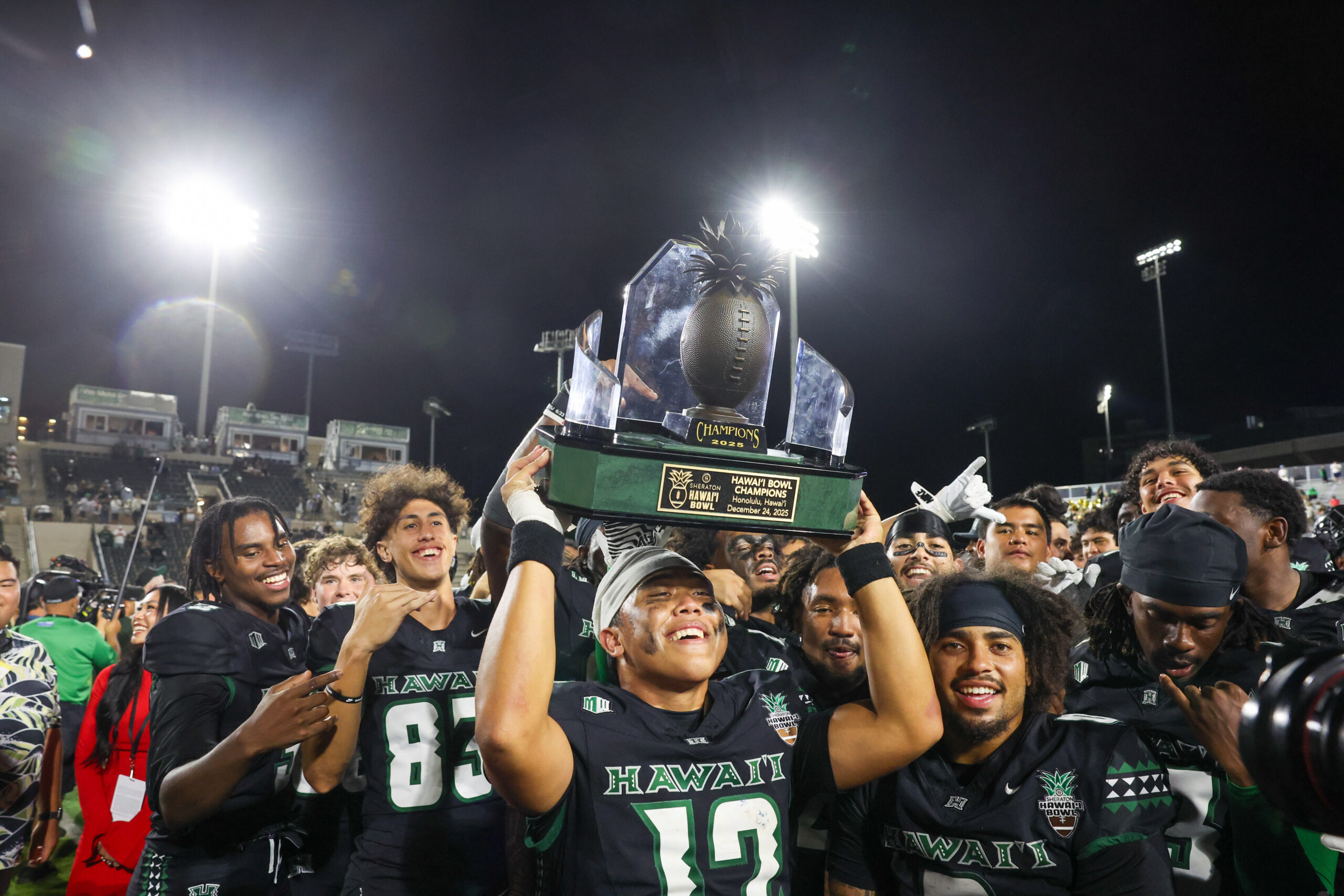
Hawaiʻi football projects as one of college football’s most intriguing 2027 playoff sleepers because a restocked roster, a proven scheme, and an expanded postseason all converge to open a realistic path from the Mountain West to the national stage. Even if Hawaiʻi opens 2027 outside the blue-blood conversation, the trend lines in recruiting and performance suggest the Rainbow Warriors could crash way-too-early playoff projections and become a popular dark-horse pick.
Changing playoff math
The first reason 2027 projections can credibly feature Hawaiʻi is that the College Football Playoff is no longer a four-team invitational that effectively shuts out most Group of Five programs. With the field already expanded to 12 and further tweaks or expansion to 16 still on the table heading, possibly as soonas next year — the gap between “New Year’s Six dream” and “full playoff berth” is shrinking a bit for top non‑power conference champions.
More at‑large spots mean a highly ranked Mountain West champion no longer needs perfection to get in, just a top‑10 to top‑12 profile with a strong strength of schedule.
Timmy Chang inherited a program that bottomed out in 2022 and has steadily nudged it back toward respectability and then contention, setting up the mid‑to‑late 2020s as the payoff window. After back‑to‑back five‑win seasons in 2023 and 2024, the Rainbow Warriors climbed to 8–4 with a fifth‑place Mountain West finish behind a much more stable roster by 2025, signaling that the rebuild had turned a corner.
The staff has leaned heavily on relationships in Hawaiʻi and Las Vegas, particularly Bishop Gorman, to replenish talent with players who fit Chang’s vision on and off the field.
Associate head coach Chris Brown and quarterbacks coach Chad Kapanui arrived with familiarity from Gorman, further tightening that pipeline and giving Hawaiʻi an identity rooted in development and continuity rather than short‑term rentals.
Roster built for a leap
Projections that push Hawaiʻi into the 2027 playoff mix start with a roster that looks more like a top‑25 Group of Five team than a rebuilding project. The 2025 and 2026 depth charts show a blend of young offensive skill talent, experienced linemen, and a veteran secondary — exactly the kind of balance that can turn into an 11‑ or 12‑win season when things break right.
At quarterback, former Bishop Gorman star Micah Alejado headlines a room that also features multiple FBS‑caliber arms, giving Chang a potential multi‑year starter capable of running an aggressive passing attack.
The skill positions are loaded with proven Mountain West playmakers like receiver Pofele Ashlock plus bigger transfer‑portal bodies on the outside, while the offensive line returns size and experience across multiple classes.
Defensively, Hawaiʻi leans on veteran leaders such as safety Peter Manuma and an upper‑class heavy two‑deep that can finally execute the multiple 4‑2‑5 structure without constant blown assignments.
Schedule and Mountain West context
A second piece of the projection puzzle is the schedule: Hawaiʻi continues to play a challenging but manageable slate that can generate playoff‑caliber résumés if the wins stack up. The 2025 schedule featured Power conference brands like Stanford and Arizona, and similar nonconference opportunities are likely to continue into 2026–27, giving the Rainbow Warriors chances for résumé‑defining victories with games at Stanford and Arizona State.
Finally, national prognosticators are always hunting for the next off‑the‑radar story, and Hawaiʻi checks every narrative box for bold 2027 playoff calls. A proud program with past high‑flying success, a former record‑setting alum as head coach, an increasingly talent‑rich roster, and the built‑in allure of late‑night island kickoffs make the Rainbow Warriors a perfect “if everything clicks” projection for an expanded field.
Early analytics and way‑too‑early brackets have already started nudging Hawaiʻi into hypothetical future CFP fields, reflecting how the program’s trajectory is being perceived outside the islands.
Bill Connelly’s ESPN playoff bracket is a huge part of why Hawaiʻi shows up in 2027 playoff conversations, because he has already built a CFP field that includes the Rainbow Warriors as the Group of Six representative and even walks through how they get there. That national validation from a leading analytic voice gives real substance to projections that might otherwise be dismissed as pure fantasy.
Connelly’s projection article lays out a full 12‑team playoff bracket, seeded from 1–12, with conference champs and at‑larges slotted according to both committee tendencies and his SP+ analytics. Within that framework, he reserves the final automatic bid for a non‑power champion and makes a deliberate choice to hand that spot to Hawaiʻi rather than a more conventional pick like Tulane.
- He notes that the committee’s handling of “ain’t played nobody” and Group of Five résumés makes access difficult, but still carves out room for a mid‑major that beats a couple of power‑conference teams and dominates its league.
- The bracket then pairs that Group of Five auto‑bid against a high‑seeded power in the first round, and in Connelly’s scenario that matchup is USC vs. Hawaiʻi, with the Trojans advancing but the Rainbow Warriors still enjoying a landmark playoff appearance.
How Hawaiʻi earns that spot
Connelly’s write‑up is explicit about the path: he projects Hawaiʻi to open and close a season with wins over power‑conference opponents and to pair those with a Mountain West title. In the scenario he sketches out, the Rainbow Warriors beat Stanford and Arizona State, win the “new‑look” Mountain West, and finish with a résumé strong enough to edge other Group of Five contenders for the CFP auto‑bid.
- He emphasizes how hard it is for programs like Hawaiʻi to even schedule those P4 games in an era of nine‑game league slates, which makes finishing 2–0 in those chances a major differentiator.
- The combination of marquee nonconference wins and a conference title is exactly the blueprint future 2027‑style projections use when they pencil Hawaiʻi in as a low seed in an expanded bracket.
Why this matters for 2027 projections
Because Connelly builds his bracket off both SP+ and recent committee behavior, his decision to insert Hawaiʻi as the Group of Five representative signals that their underlying trajectory matches the numbers, not just a feel‑good story. That makes it much easier for other analysts to project a 2027 field that includes a similar version of Hawaiʻi: a program with a top‑25ish profile, a Mountain West title, and at least one or two P4 scalps.
- Social and fan‑driven reactions have already highlighted the novelty of seeing Hawaiʻi printed into an ESPN playoff field, noting them as the surprise No. 12 “Aloha” team in the projected CFP.
- For any article or projection about 2027, pointing back to Connelly’s bracket gives a concrete precedent: Hawaiʻi has already been diagrammed into a real ESPN playoff bracket, which validates including them again in forward‑looking CFP scenarios.
For analysts and fans looking to differentiate their 2027 projections, putting Hawaiʻi into a bottom‑seed playoff slot captures both the reality of an expanded format and the romantic idea of a surging Mountain West power breaking through.